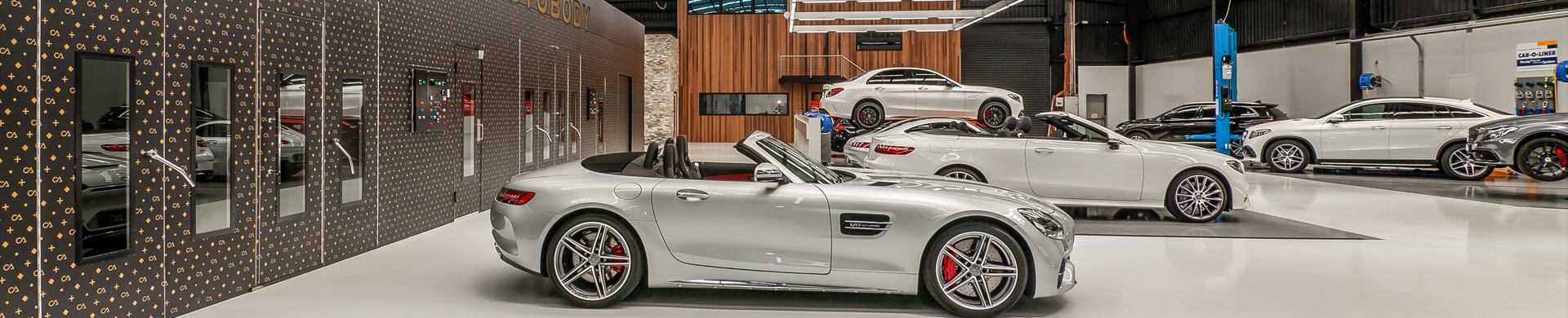

Paintless dent removal, or PDR, fixes a dent by pushing the metal back where it came from instead of filling it and painting over it. No filler, no primer, no respray. The paint that leaves our workshop is the paint the factory put on.
That is the whole appeal. A dent that goes through a traditional repair means sanding, filler, primer, colour, clear and a blend into the neighbouring panels. A dent that comes out with PDR keeps its original finish, costs less, and is usually back with you far sooner. It also keeps the car honest at resale time, because there is no repainted panel to explain.
We do paintless dent removal at our workshop in Chelsea Heights for drivers across Melbourne’s south east, from shopping centre door dings through to a bonnet and roof full of hail. Call 03 9772 7411 or send us a few photos and we will tell you honestly whether your dent is a PDR job or not.
Steel and aluminium panels have a memory. When a panel is dented the metal stretches and locks itself into the new shape, but the surrounding metal is still trying to pull it back. PDR is the craft of releasing that tension in the right order so the panel settles where it started.
There are two ways in. From behind the panel, using rods fed in through a door frame, a tail light aperture or a drain hole, the technician pushes the low points up a fraction at a time while watching the reflection of a lined board across the paint. From the front, using glue tabs bonded to the surface and pulled with a slide hammer or a lifter, then tapped back down where the pull has gone slightly too far. Most real dents use both.
The reflection board is the part people do not expect. A technician is not looking at the dent, they are looking at how a straight line bends as it crosses the panel. That is the only way to see a dent down to tenths of a millimetre, and it is why a good PDR repair becomes invisible rather than nearly invisible.
We would rather tell you up front than take the car in and give you bad news later. PDR is the right answer when:
It is the wrong answer when the paint is broken, when the metal has torn or stretched badly, when a dent sits right on a swage line, or when there is bracing, sound deadening or a structural member directly behind the damage. Those go to panel beating and spray painting instead, and we will say so.
Aluminium panels are harder than steel. Aluminium has far less memory, it work hardens quickly, and it usually needs controlled heat. It is still often doable, but it takes longer and not every dent in aluminium will come out.
Melbourne gets hail in short, violent bursts, and a single storm can leave a bonnet, roof and boot covered in dozens of small dents. Hail is the best case for PDR: the dents are shallow and round, the paint is usually intact, and replacing or repainting three large panels is far more expensive than working the dents out.
Hail work is slow and methodical rather than difficult. We assess the car panel by panel, count and map the dents, and give you a realistic time frame before anything starts. If your insurer is involved we deal with them directly, and a hail claim is one of the places where choosing your own repairer matters most, because volume hail operations work to a very different standard.
We are an approved repairer for Tesla, BYD, Zeekr and Lexus, which means we work to each maker’s procedures rather than a generic method. That matters for PDR because modern panels are thinner, often aluminium, and frequently have sensors, wiring or battery structure sitting directly behind them. Knowing what is behind a panel before a rod goes in is not optional. If you drive a Tesla, our Tesla approved repair centre page covers how we handle those cars.
We look at the panel with a reflection board, not with the naked eye in a car park. That tells us how many dents there really are, how deep they go, and whether the paint has been stressed.
You get told whether it is a PDR job, a partial PDR job, or a repair and respray. We would rather lose the job than take money for a repair that will not hold.
Trim, door cards, tail lights or liners come out as needed so we can reach the back of the panel, then go back exactly as they came out.
Rods, glue pulling and tapping, checked against the board continuously. This is the slow part and it cannot be rushed without leaving high spots.
The panel is checked from several angles under different light, then polished. You should not be able to find where the dent was.
We are an approved repairer for AAMI, RACV and NRMA and work with every major insurer. On smaller dents it is worth doing the sums first, because a PDR repair is often close to the excess, in which case paying for it directly keeps your claims history clean. We will tell you where your job sits rather than pushing you into a claim.
If the dent came from an accident that was not your fault, you can generally choose your own repairer. Our accident assistance page explains how that works, and we can arrange a replacement vehicle if you need one.
We are at 7 Ashley Park Drive, Chelsea Heights, and we offer free pickup and drop off valet in our service area, which covers Cheltenham, Mentone, Mordialloc, Carrum Downs, Chelsea and the rest of the bayside and peninsula suburbs on our areas we serve page.
It is a repair method that reshapes a dented panel from behind or with glue pulls, so the factory paint is never disturbed. No filler, no primer, no respray.
Done properly, no. The paint is never sanded or sprayed. The risk is in the hands doing it: too much force in one spot leaves a high spot or cracks the clear coat, which is why the work is done slowly and checked against a reflection board the whole way through.
A single door ding is often a couple of hours. A bonnet with a handful of dents is most of a day. Full hail damage across several panels runs into days, and we give you a time frame after seeing the car rather than over the phone.
Almost always, because there is no paint, no materials and no blending into adjacent panels. The saving is biggest on hail, where the alternative is refinishing or replacing several large panels.
No, and anyone who tells you otherwise is selling something. Broken paint, sharp creases, stretched metal and inaccessible panels all rule it out. We will tell you which category yours is in before you commit.
It helps. A panel that still wears its factory paint is worth more than a repainted one, and PDR leaves nothing for a paint depth gauge to find.
Yes, and it is a common reason people come to us before handing a car back. Getting dings out without a respray usually costs less than the end of lease damage charge.
The work is done at our Chelsea Heights workshop, where the lighting and the equipment are, but we offer free pickup and drop off in our service area so you do not have to lose a morning to it.
Alongside paintless dent removal we handle panel beating, spray painting and colour matching, accident assistance and replacement vehicles, and we are an approved repairer for Tesla and Zeekr. Every repair carries our lifetime warranty on parts, and our Google rating sits at 4.9 across more than 350 reviews.



Tell us what happened
Send us the details and we will come back to you with the next practical step. No obligation, and we are happy to help even if you repair elsewhere.
Had an accident? Call us 03 9772 7411
7 Ashley Park Drive, Chelsea Heights VIC 3196
Monday to Friday, 8:00am to 5:00pm
Your details
We usually reply the same business day.
Loading the form…
The form did not load. Please call 03 9772 7411 or use our contact page.
Your details are only used to respond to your enquiry and are handled under our privacy policy.
Thanks, we have your enquiry
We will be in touch shortly. If your car is not driveable, call 03 9772 7411 now and we will organise towing.



